I’ve been
fortunate enough to receive wide acclaim already for my Sundown Press novel THE PEACEMAKER, including 5 star
reviews from 2 of the most successful western authors in the business. Spur
award-winning and Pulitzer Prize-nominated author ROBERT VAUGHAN describes it
as ‘a great book’. Meanwhile RALPH COTTON (also a Pulitzer-prize nominated
novelist) writes: ‘For pure writing style, McBride’s gritty prose nails the
time and place of his story with bold authority. …this relatively new author
has thoroughly, and rightly so, claimed his place among the top Old West
storytellers.’ I’m very grateful to both Robert & Ralph for their fantastic
support.


http://www.paulbishopbooks.com/2017/12/britwest-wrangling-words-with-andrew.html

Here’s the text of his interview:
Andrew
McBride is another of the stellar writers continuing the tradition of popular
western novels written by British authors. Following the trail-blazing efforts
of J.T. Edson, Matt Chisolm, the Piccadilly Cowboys and others, Andrew has seen
6 of his westerns published, all featuring Calvin Taylor as the central
character. Happily, Andrew has taken the time to step out of the saddle and
join us round the campfire for a chat…
If it was tacked
up in the Sheriff’s office, what information would be included on a Wild West
wanted poster with your picture on it? (a convoluted way
of asking for some bio details about you)
Andrew
McBride. Aged about 63. Last seen in Brighton, England. Wanted for writing 6 published
western novels: CANYON OF THE DEAD, DEATH WEARS A STAR, DEATH SONG, THE ARIZONA
KID, SHADOW MAN and THE PEACEMAKER.
What was your
introduction to Westerns—movies, TV, or books?
TV.
I made a schoolboy friend in 1967 and his family had the new TV channel BBC 2
so I used to go round to his house to watch that. One of its signature shows
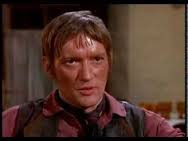
was the new TV Western series ‘The High
Chaparral’ which immediately impressed me with its grittiness, authenticity
and location photography – I fell in love with the physical beauty of Southern
Arizona. I’ve blogged about my appreciation for the HC. My latest western THE
PEACEMAKER is partly based on a HC episode, so it’s sort of my homage to the
show, a mere 49 years later. The HC kicked off my love for western movies,
particularly those starring John Wayne and/or directed by John Ford.


What was the first
Western you read?
I’m
probably remembering this too neatly but watching the HC with my schoolboy pal
sparked an interest in western history and Native American culture. He got
interested in the historical background to the show too and was reading a novel
called ‘Broken Arrow’ which was a
junior version of Elliot Arnold’s great novel ‘Blood Brother.’ This is all about the great Apache chief Cochise. I
read it and nearly half a century finally wrote my own novel with Cochise in it
- THE PEACEMAKER. When I was in my early 20s, another pal turned me onto the
McAllister westerns by Matt Chisolm and started me off reading westerns
regularly – people like Gordon Shirreffs, Will Henry, Fred Grove and Robert
MacLeod.
What was it about
the genre you found compelling enough for you to want to write a Western?
I’ve
always been drawn to adventure stories set outdoors. I can’t see myself writing
an urban novel. I like having my characters tested by the struggle to survive
in a wilderness. For me westerns ticked every box – they not only had conflict and action
in plenty but also strong dramatic tension because they’re essentially
morality plays about the fight between right and wrong.
They deal
with a broad range of moral dilemmas that the settlement of the West threw up:
How do you tame a wilderness without destroying it? How much violence is
necessary (and how much is excessive) in creating a law-abiding society? How
can diverse cultures (for example the white man and the Native Americans)
co-exist? All painted on a canvas of physical beauty and diversity. And there’s
a lot of tragedy in western history – what happened to the Native Americans,
for example, and to the basic environment – that’s the stuff of high drama.
There’s also beauty and poetry in the language, not only the laconic speak of
everyday westerners but even in real names – when I first read about the Alamo,
and people called Travis, Crockett, Bowie, Santa Anna etc. I was hooked!
Had you written
books before, or was your first Western your literary debut?
My
western CANYON OF THE DEAD was my literary debut. Before that I’d written a
couple of books yet to see the light of day – another western and a novel on
the Arthurian legend. I’ve also written some contemporary thrillers since, but
oddly enough, it’s the westerns – which I would have thought were the least
commercial of my output - that have got published.
How do you see the
current state of the Western genre?
I
don’t really know. Based in Britain, I’d assumed western publishing was pretty
moribund – the only UK publishers I was aware of doing westerns was Robert Hale
(since taken over by Crowood Press.) But since starting on Social Media a year
ago I’ve become aware that there’s a lot going on – Piccadilly Publishing and a
bunch of publishers over in the States. So, it appears a lot healthier than I’d
thought.
And despite being written off 40 years ago, western movies and TV
shows keep popping up and occasionally succeed. I can’t say I’ve been too
impressed by most of the recent re-makes of classic movies. I haven’t gone for
some of these hybrids either (‘Cowboys
and Aliens’ etc.) I’d like to see an original western film succeed on its
merits, as ‘Unforgiven’ did, not just
because it’s some kind of whacky novelty. However, whilst I can’t see the western
ever coming back to the heights it commanded in the 1950s and ’60s, there seems
to be plenty of life left in the old dog yet!

'Unforgiven' (1992)
What was your
journey to getting your first Western published?
In
1982 I submitted a western called SHADOW MAN to Robert Hale. They rejected it –
quite rightly, as it wasn’t good enough. A dozen years later an author friend
of mine – Philip Caveney – mentioned Hale were still looking for westerns, so,
rather than writing a new one I dug out SHADOW MAN from the bottom of a drawer,
dusted off the cobwebs and looked at it again. I re-wrote about half of it,
re-submitted it to Hale and they accepted it – only they had another book
called SHADOW MAN coming out. So I re-titled mine CANYON OF THE DEAD. It came
out in 1996, 14 years late. As a sort of post-script, I later wrote another one
for Hale – again called SHADOW MAN – and they published it in 2008. So getting
one form of SHADOW MAN out there took 26 years!
Have you been to
the West, and if not, how do you do your research?
Yes,
I’ve been to the west, although not to some of the areas I write about. I think
my first ‘western’ experience was when we were driving southwest from San
Antonio, Texas, towards Mexico. San Antonio was great but it seemed more
southern and Mexican than western. We
stopped at a place called Cotulla, Texas, on the Nueces River and getting out
of the car I suddenly felt the wind blowing warm desert heat and a peppering of
dust on my skin. That’s when I knew I was ‘west.’
To me the west starts with two things: when it gets empty, and there’s wide
open spaces and big skies; and when it gets dry. But I don’t think you need to
have been there to write about it. When he started writing westerns Elmore
Leonard, who wrote classics like ‘Hombre’,
was living in the Midwest and had never been west of the Mississippi.

As I’m
interested in the history of the west I’ve accumulated a library of reference
books, such as The Old West Time Life series. And the internet is fantastic. If
20 years ago a Brit writing a western wanted to describe say, Apache Mountain
Spirit Dancers, he’d have to go to his local library and hope they had a book
about them – otherwise he’d have to order one in and wait a month until it
arrived. Now, in 5 minutes, you can google Apache Mountain Spirit Dancers, read
about them and watch a Youtube video of them.
Is there any
difference between Westerns written by British writer’s and Westerns written by
homegrown American writers?
I
don’t think so, if they’re skillful enough to hide their ‘Britishness’. I’m a great fan of Elmore Leonard but I noticed,
reading some of his westerns, he’d get little facts wrong, names of plants etc.
So I wasn’t surprised to discover that when he started writing westerns he was
living in the Midwest and had never been west of the Mississippi. On the other
hand I read ‘The Buffalo Soldiers’ by
John Prebble and the McAllister westerns by Matt Chisolm and thought both
authors had totally authentic ‘American’
voices – so I was pretty surprised to discover both were British.

Do you currently
read Westerns, and if so, who is/are your favorite Western author(s)?
I’ve
always read widely, not just westerns, but I still read them. In the past,
alongside the authors I’ve already mentioned, I read Jack Schaefer, Glendon
Swarthout, Dorothy M. Johnson, Thomas Berger, Charles Neider, Louis L’Amour,
Louis B. Patten, A. B. Guthrie jnr. etc. Since engaging with Facebook I’ve
become aware of and FB friends with authors like J.R. Lindermuth, Robert
Vaughan and Ralph Cotton, all of whom were kind enough to give good reviews to
THE PEACEMAKER. I reviewed Ralph Cotton’s novel ‘While Angel’s Dance’, about the James Gang, and gave it 5 stars –
which is a very rare thing for me to do.
And there’s lots more I intend to check out.
Do you have a
writing mentor?
I did
have. I started reading out my stuff at writing groups in the 1980s. At one
of them, a guy called Philip Caveney suggested I seriously consider writing for
a living.
That
impressed me because he was the first person to take me seriously as a writer,
and I valued his opinion because he was also the first published author I’d met
– he’s been successful writing thrillers and now children’s fiction – so I
reckoned he knew what he was talking about. So it’s all his fault!
I still
go to a writing group, a small band who critique each others work. I think
getting constructive criticism and positive (but not fawning) feedback is
essential to mastering the nuts and bolts of how to write well.
When you start
writing a new Western, do you pick a standard Western plot (I think there are
about six) and look for a way to turn it on its head, or do you look to history
or some other source for inspiration?
You
can argue until the cows come home about how many basic plots there are to
anything. I do think it’s better to try a ‘new wrinkle’ on things rather than
just re-cycling clichés. Plotting’s not my greatest strength, so I often look
to history for inspiration. DEATH WEARS A STAR was a fictionalisation of the
Earps in Tombstone story, and THE ARIZONA KID fictionalized Billy the Kid’s
story. There was something of Lt. Howard Cushing – a cavalry officer who fought
Apaches – in DEATH SONG. I also have a friend I nickname ‘Dr. Plot’ who’s good at helping me out when I get stuck about what
happens next. Western author Thomas Rizzo, one of my FB friends, keeps a
wonderful blog and almost daily posts little vignettes of historical frontier
escapades. Anybody stuck for an idea for a novel only needs to visit his blog
and they’d find material for 20 westerns!
Where do you stand
of indy versus small press versus traditional publishing?
I
haven’t gone into it in depth but, if I had plenty of money and time, I might
consider self publishing. It cuts out the middle man but I suspect it requires
a huge amount of time and effort on Social Media and self-promotion just trying
to attract an audience. For me the best model is still a publisher who pays you
a fair advance and does most of what we in Britain call ‘the donkey work’ for
you – e.g. promotion, advertising etc. – and leaves the writer to mostly write.
It may be an increasingly impossible dream but that’s what I hanker for.
What is your
latest Western and what are you currently writing?
I
have two novels with publishers – one about Robin Hood, and another western.
I’m finishing up a project that’s so different from what I normally do, I’m
keeping very quiet about it. Sorry about the mystery. It wouldn’t fit the
Andrew McBride canon so I’d have to publish it under another name. I’ve started
another western which I hope to launch into properly by next February. It’s
going to have an elegiac, ‘Wild Bunch-y’
end of the west feel. That’s the plan anyway, but you know what Robbie Burns
said about plans! (‘The best laid schemes
o’ Mice and Men, Gang aft agley, An’ lea’e us nought but grief and pain, For
promis’d joy.’)

Robbie Burns
BLURB for THE PEACEMAKER:
Eighteen-year-old scout Calvin
'Choctaw' Taylor believes he can handle whatever life throws his way. He’s been
on his own for several years, and he only wants to make his mark in the world.
When he is asked to guide peace emissary Sean Brennan and his adopted Apache
daughter, Nahlin, into a Chiricahua Apache stronghold, he agrees—but then has
second thoughts. He’s heard plenty about the many ways the Apache can kill a
man. But Mr. Brennan sways him, and they begin the long journey to find Cochise—and
to try to forge a peace and an end to the Indian Wars that have raged for so
long. During the journey, Choctaw begins to understand that there are some
things about himself he doesn’t like—but he’s not sure what to do about it.
Falling in love with Nahlin is something he never expected—and finds hard to
live with. The death and violence, love for Nahlin and respect for both Cochise
and Mr. Brennan, have a gradual effect on Choctaw that change him. But is that
change for the better? Can he live with the things he’s done to survive in the
name of peace?
EXTRACT:
Choctaw blinked sweat and sunspots out of his eyes and began to lower the field glasses; then he glimpsed movement.
He used the glasses again, scanning nearer ground, the white sands. He saw nothing.
And then two black specks were there suddenly, framed against the dazzling white. They might have dropped from the sky.
They grew bigger. Two horsebackers coming this way, walking their mounts. As he watched they spurted into rapid movement, whipping their ponies into a hard run towards him.
The specks swelled to the size of horses and men. Men in faded smocks maybe once of bright colour, their long hair bound by rags at the temple. They had rifles in their hands.
Breath caught in Choctaw’s throat. Fear made him dizzy. His arms started to tremble. He knew who was coming at him so fast.
Apaches.
And you killed them or they killed you.
****
To buy THE PEACEMAKER visit Amazon.com:
or Amazon.co.uk: